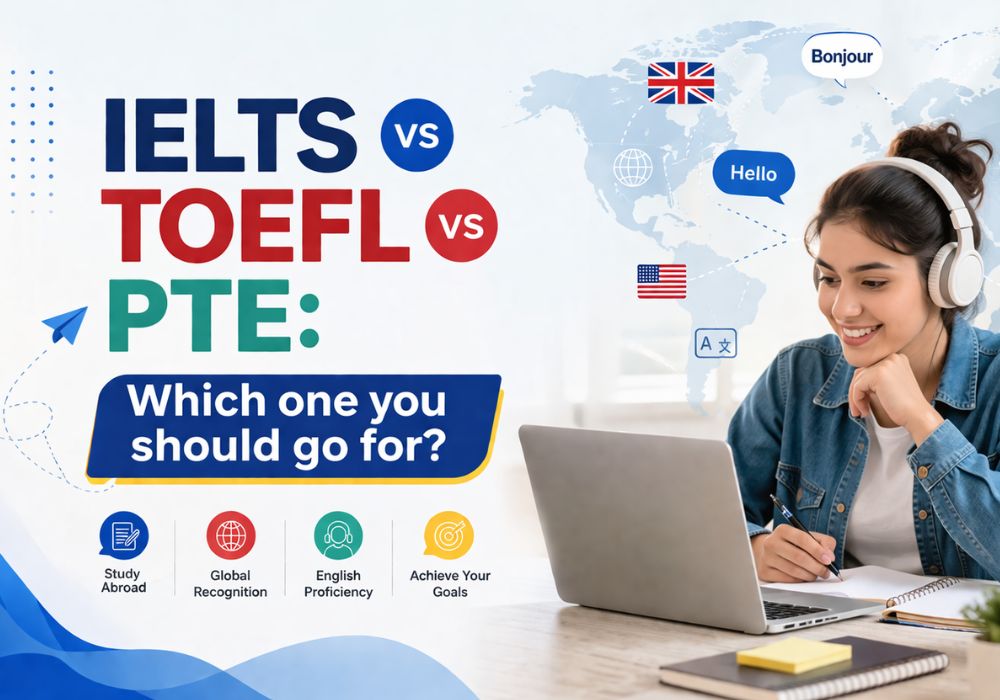
If you want to study in a foreign country, then you need to you need to clear the exam that tests you on the English language. Foreign universities require applicants from those countries where English is not the native language to submit proof of their proficiency in speaking, writing, hearing, and understanding English. IELTS, TOEFL and PTE these three are the ways to test how proficient they are in English.
However, which English language test should you choose to take? The decision depends on various factors, such as which test is accepted by the university you’re applying to, the availability of exam centers near you, your budget, and more.
So, everyone asked that which one is better and easier. But unfortunately, there is no genuine answer. Let’s closely examine the differences between TOEFL, IELTS, and PTE.
Format of the IELTS, TOEFL and PTE exams
IELTS, TOEFL, and PTE are English language proficiency tests with different formats and structures. Let’s know in-depth about them.
What is IELTS?
IELTS, which stands for the International English Language Testing System, is an exam that can be taken for employment or academic purposes in settings where English is the main language of communication. IELTS is the most widely taken test for assessing English language proficiency. It has a global footprint with test centers in approximately 140 countries and is recognized and trusted by over 12,000 organizations around the world.
This test has four categories: Listening, reading, writing and speaking. Each section is scored in half-point increments, ranging from 0 to 9. The overall IELTS score is then calculated by averaging the section scores. IELTS used to be taken paper-based but currently, it can be taken computer-based as well. IELTS is the most preferable test around the world. Simultaneously, it is hard to crack.
What is TOEFL?
Test of English as a Foreign Language commonly known as TOEFL, is the oldest English language proficiency test introduced in 1964. TOEFL scores are recognized in more than 160 countries worldwide and are accepted by almost 12,500+ universities and institutions. It can be taken by paper-based or computer-based as well. The paper-based TOEFL test lacks a speaking section, which is why some universities do not accept it.
TOEFL also provides scores for reading, writing, listening and speaking. Each section is scored on a scale of 0 to 30. Your total TOEFL score is the sum of these sections, with a maximum possible score of 120. It has four sections like IELTS but this test is a little more difficult than IELTS.
What is PTE?
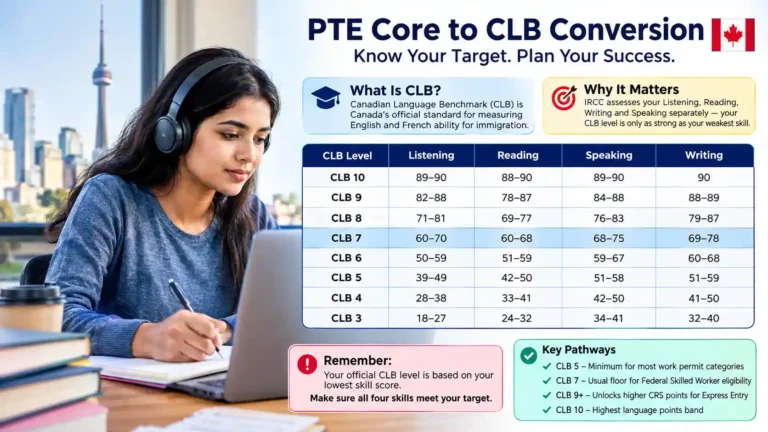
PTE stands for the Pearson Test of English, which is completely a computer-based test that covers reading, listening, writing, and speaking. This test has been available since 2009. It assigns scores ranging from 10 to 90, with 90 being the highest. Anywhere above 76 is a good score.
The test was initially designed to assess British English, but it is also capable of evaluating American English. PTE is particularly popular in New Zealand and Australia. However, it has spread to other countries as well.
Score comparison of IELTS VS TOEFL VS PTE
If you want to get a degree from an English-speaking country then you need to achieve a certain score in these English language proficiency tests. Each test has 4 sections which are listening, reading, writing and speaking. However, there are so many differences in the marking criteria for these exams. Let’s know how these three tests are scored:
- TOEFL – This test is scored on a scale of 0 to 120 points. To receive a score, you must respond to at least one question in both the reading and listening sections, answer at least one question in the speaking section, and complete one essay.
- IELTS – This test is scored on a scale from 0 to 9, with each of the four sections being rated individually, and the overall score being the average of these four.
- PTE – This exam follows the Global Scale of English and is graded between 10 and 90 points.
Comparison of the test sections of IELTS, TOEFL and PTE
IELTS, TOEFL and PTE each one of them has same four sections, which are listening, reading, writing and speaking. But the exam procedure is so different.
TOEFL vs IELTS vs PTE: Reading
The reading sections for these three exams involve reviewing brief passages and responding to questions related to them. The passages are different for each test. In these three tests, the reading section is similar. However, IELTS and TOEFL take longer time than PTE.
| IELTS | TOEFL | PTE | |
| Number of questions | 40 | 20 | 15-20 |
| Number of passages | 3 | 3-4 | 5 |
| Duration | 60 minutes | 35 minutes | 29 to 30 minutes |
TOEFL vs IELTS vs PTE: Listening
Listening is also included in these three tests. Test-tackers have to listen to recorded audio and answer all of those questions. Mostly everyone is comfortable in this section except others.
| IELTS | TOEFL | PTE | |
| Number of questions | 40 | 28 | 18-25 |
| Number of recordings | 4 | 6-9 | 8 |
| Duration | 30 minutes | 36 minutes | 30 to 43 minutes |
TOEFL vs IELTS vs PTE: Speaking
The structure of the speaking section varies significantly across the three tests. In TOEFL and PTE tests there is a microphone to record the candidate’s answer. On the other hand, IELTS examinees can take their speaking section by face-to-face or computer-based interview. Further, PTE also combines speaking and writing, so this test section takes longer.
| IELTS | TOEFL | PTE | |
| Number of tasks | 3 | 4 | 5 |
| Format | In-person / Computer | In-person / Computer | Computer |
| Duration | 11 to 14 minutes | 16 minutes | 40 to 50 minutes |
TOEFL vs IELTS vs PTE: Writing
Among the three exams, the IELTS test is often considered to have the most challenging writing section. This could be because it focuses solely on evaluating the test-taker’s writing abilities, whereas both the TOEFL and PTE assess a combination of writing, reading, and listening skills. Each of the three tests contains two writing tasks.
- IELTS: The first task requires you to describe and summarize information from a chart, graph, or diagram. The second task asks you to write an argumentative essay on a given topic.
- TOEFL: In the first task, you’ll need to summarize both a written and an audio passage. The second task involves writing an essay on a specific topic.
- PTE: The first task is to summarize a passage in a single sentence. Like the other tests, the second task involves writing an essay.
| IELTS | TOEFL | PTE | |
| Format | Paper / Computer | Paper / Computer | Computer |
| Number of tasks | 2 | 2 | 2 |
| Duration | 60 minutes | 29 minutes | 30 to 40 minutes |
School Recognition of TOEFL, IELTS, and PTE Tests
Many schools in English-speaking countries widely accept these three exams, but they are different. Each institution sets its own guidelines on which tests they accept and the minimum score they require. To understand how each test can enhance your chances of being admitted to top universities first, you need to research to know how much score you need to get admission to universities.
Eventually, these three tests are the way to continue your higher education in abroad. You can do your study in those countries which are famous for their education system by these three tests. Therefore, you need to choose a country or university simultaneously which recommendation they want.
Validity and expenses associated with the TOEFL, IELTS, and PTE tests
All these three tests are approximately the same but there is no difference in validity.
All information is given below:
| IELTS | TOEFL | PTE | |
| Cost | 215 – 240 USD | 205 USD | 235 USD |
| Validity | 2 years | 2 years | 2 years |
Advantages and Disadvantages of IELTS, TOEFL and PTE Exams
There are several merits and demerits in these three tests. Nevertheless, their positive sides outweigh the negative sides.
The following table lists the advantages and disadvantages of IELTS vs TOEFL vs PTE:
Advantages
| Aspect | IELTS | TOEFL | PTE |
| Global Recognition | Widely recognized worldwide | Recognized globally | Growing acknowledgment |
| Test Format | Provides both Academic and General Training formats | Primarily Internet-based Test (iBT) format | Entirely computer-based |
| Face-to-Face Speaking | Includes an in-person speaking element | Speaking tasks that are integrated mimic real-world situations | Combined speaking and writing sections |
| Scoring Transparency | Transparent proficiency level scale | Uniform grading based on accurate responses | Automated scoring system |
| Quick Results | Scores available within 13 days | Instant score reporting online | Results will be ready within 48 hours |
Disadvantages
| Aspect | IELTS | TOEFL | PTE |
| Limited Test Dates | Test dates might be restricted in certain areas | Restricted options for test dates in certain areas | Some areas have a restricted number of test centers available |
| Subjectivity in Speaking | Speaking scores can fluctuate based on the examiner | Reduced familiarity with British English accents | Restricted human engagement in the speaking section |
| Handwriting Requirement | The writing portion needs to be done by hand | N/A | N/A |
| Less Flexibility | It mainly provides Academic and General Training formats | Primarily offers iBT format | Not as widely recognized in certain areas |
IELTS vs TOEFL vs PTE- FAQs
- How long do the IELTS, TOEFL and PTE tests take to complete?
The duration of these exams is almost the same. And these are: IELTS 2 hours 45 minutes, TOEFL 3 hours, and PTE 2 hours 15 minutes.
- Does the exam test British or American English?
These three tests examine both British and American English.
- Where are the English language tests accepted?
All three English language exams are widely recognised and accepted by numerous institutions around the world. IELTS is accepted by over 10,000 institutions in over 140 countries. TOEFL is accepted by more than 11,500 universities and other organisations in over 160 countries. Moreover, PTE Academic is also accepted by thousands of institutions in numerous countries.
- How and where can I take each test?
IELTS- You can take the IELTS Academic test on a computer or on paper at a test centre. Starting from early 2023, you will also be able to take IELTS Academic online from the comfort of your home. In terms of structure, content and timing of the test, there are no differences between the computer, paper-based, and online test. The Speaking part is face-to-face with a certified IELTS examiner or through a video call.
TOEFL- TOEFL® iBT is offered as a computer-based exam in official test centres, but there is a Home Edition (can be taken using a personal computer at home) and a Paper Edition (for locations where the internet is not available. The Speaking part will be taken from home, using a personal computer.
PTE- PTE Academic is available in computer-based format in a network of test centres around the world. The same test is available as PTE Academic Online, which can be taken from home; however, this version is not accepted for study visas, and many institutions only accept PTE taken in a test centre.
- How difficult are IELTS, TOEFL and PTE?
It’s challenging to assess which English proficiency test is more difficult. Keep in mind that the way you prepare for an exam is more important than how difficult it is or what people say. These tests are not meant to be obstacles, but rather an opportunity to prove you have the English skills to live and study in a foreign country.
Successfully passing an English language test shows you’re motivated and disciplined enough to work hard, which makes you an ideal candidate for undergraduate (Bachelor’s) or postgraduate (Master’s, PhD) studies.
- Which of the TOEFL, PTE, and IELTS Tests Should I Take?
While IELTS is traditionally more aligned with British and Australian English, TOEFL is generally more focused on American English. PTE Academic, however, uses a mix of international accents, including British, American, and Australian English. IELTS is widely accepted in the UK, Australia, Europe, and many other countries, while TOEFL is especially popular among universities in the United States.
PTE Academic, although newer compared to IELTS and TOEFL, is now accepted by thousands of institutions worldwide, including universities in Australia, Europe, the UK, and several prestigious institutions such as Harvard Business School and Yale.
Ultimately, difficulty is not the major factor. But the fact is, you have to think about which test style you are comfortable with.