You study the strategy. You practise it. You feel confident going into the test.
Then you get your score back, and the Speaking section is lower than expected. Sound familiar?
This happens to a lot of students preparing for the PTE. The first-person restatement strategy for responding to a Situation is popular and widely taught, and there’s a real reason for that. But there’s a specific way students misuse it, and that misuse is costing them marks.
Here’s exactly what’s going wrong and how to fix it.
What Is the Respond to a Situation Task?
Respond to a Situation (often abbreviated as RTS) was added to PTE Academic and PTE Academic UKVI on 7 August 2025. Before that date, it only appeared in PTE Core.
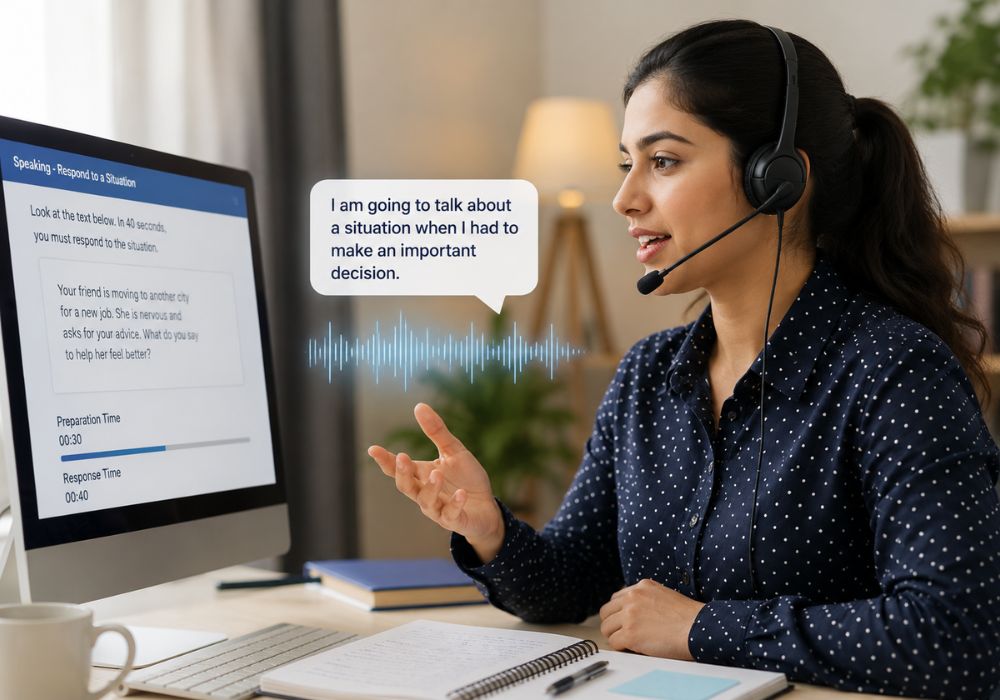
You read and hear a short scenario, up to 60 words, describing a real-world situation. You have 10 seconds to prepare, then 40 seconds to speak your response.
You’ll typically get two to three of these tasks in a single exam session.
The situations are practical and everyday. Things like asking a professor for a meeting, requesting help with a group project, or handling a scheduling conflict.
Pearson describes the goal as testing whether you can respond naturally and effectively to common situations you might encounter as a student.
How Scoring Works for This Task
The RTS task uses partial credit scoring across three criteria.
| Criterion | What It Measures | Who Scores It |
| Content | Did you actually respond to the situation? Is it relevant and original? | AI + Human review |
| Pronunciation | Are you clear and understandable? | AI only |
| Oral Fluency | Does your speech flow naturally? | AI only |
Note: Pronunciation and Oral Fluency are only scored if your Content score is greater than zero.
If the AI and human reviewer disagree on the Content score, a second human reviewer makes the final decision.
Content carries the most weight for this specific task. And since August 2025, a human examiner has also reviewed content quality, not pronunciation or fluency, but whether what you said makes sense and addresses the situation.
That human check matters because it was introduced precisely to catch responses that sound fluent but miss the point. If you rely purely on a template without responding, there’s now an extra layer of evaluation to flag that.
The First-Person Strategy
The prompt always describes the situation in the second person. “You are working on an essay… You approach your professor.”
When you speak, you shift to first person. Instead of restating the scenario as written, you speak as though you are in that moment. “I’m working on an essay, and I’m struggling to organise my ideas. Could I come to your office to discuss it?”
This works because it sounds natural. It sets up context quickly. It signals to both the AI and the human reviewer that you understand the situation.
Experienced PTE instructors who teach this strategy are giving you good advice.
Where Students Go Wrong
A lot of students think the first-person restatement is the whole answer. They convert the prompt into first person, add a short template phrase at the start (“Hi, I just wanted to let you know…”) and another at the end (“I would really appreciate your help. Thank you.”), and then stop.
That structure might fill 15 to 20 seconds. The microphone stays open for 40 seconds.
More importantly, you’ve only described the situation. You haven’t responded to it.
The content criterion specifically checks whether you “addressed the situation effectively” and “achieved the goal described in the task.” If the task says to ask for a meeting, you need to ask. If it says to suggest a solution, you need to suggest one.
Restating the situation tells the examiner what’s happening. Responding to it tells the examiner what you’re going to do about it.
The Two-Part Structure
Think of your 40 seconds in two halves.
First half, establish context using first person. This is the restatement part. Shift the prompt into first person and set up why you’re speaking. This part works well, and you should keep doing it.
Second half, actually respond. This is where most students drop marks. Depending on what the situation asks, your response might be:
- A request (“Could I come to your office tomorrow to talk this through?”)
- An explanation of what you plan to do (“I’ll make sure to finish my section by Friday so the group isn’t affected.”)
- An apology with a proposed solution (“I’m really sorry about missing the meeting. Would it be possible to catch up later this week?”)
- A polite question asking for what you need (“Would you be able to let me know the submission deadline again?”)
It doesn’t have to be elaborate. It doesn’t have to be perfect. But there must be some form of genuine response in the back half of your answer.
A Practical Example
Prompt: You are working on a group assignment, and you realise you will not be able to finish your section on time. You send a voice message to your group members.
Weak response (common mistake): “Hi everyone, I’m working on our group assignment, and I’ve realised I won’t be able to finish my section on time. I just wanted to let you know. Thank you for understanding.”
That’s the situation restated in first person with a template wrapped around it. It doesn’t respond to anything.
Stronger response: “Hi everyone, just letting you know I’m running behind on my section of the group assignment. I won’t have it finished by tonight. I’m sorry about the short notice. I think I can get it done by tomorrow morning if that works. If you need to adjust the timeline or redistribute tasks, just tell me, and I’ll help sort that out.”
Same situation. Same first-person shift at the start. But the second half handles the situation, an acknowledgement, a proposed solution, and an offer to help with adjustments.
What “Any Sort of Response” Means
Keep in mind: you do not need a perfect, ideal-world response. The RTS task is not testing whether you make the best possible decision in the scenario.
It’s testing whether you can communicate in English when a situation requires it.
Your response can be simple. It can leave some things open-ended. It just needs to show that you engaged with what was being asked of you, not just described it.
This is good news for students who feel like their English isn’t advanced enough to give a sophisticated answer. You don’t need sophistication. You need a response.
Avoid Over-Relying on Templates
From August 2025, human reviewers are checking content quality as part of the scoring process. The updated scoring guidance from Pearson confirmed that responses must be original and relevant, not recited from memory.
Using a template as a rough framework is fine, but a response built around pre-rehearsed phrases with the prompt text slotted in will likely score poorly on content.
Using a template structure as a starting framework is fine. That’s organisation, not memorisation. But if your entire response is a pre-rehearsed phrase with the prompt text slotted into the middle, the content score will reflect that.
What helps is practising the second half of your answer, the responding part, across lots of different scenarios.
Quick Reference
| Part of the Answer | What to Do | Approx. Time |
| Opening | Greet or acknowledge the situation (“Hi [name]”, “Excuse me, Professor”) | 3–5 seconds |
| First half | Restate the situation in first person | 15–18 seconds |
| Second half | Respond, request, solution, explanation, or action | 15–18 seconds |
| Close (optional) | Brief, polite close if time permits | 3–5 seconds |
One Thing Most Students Never Check
When you’re practising, record yourself and listen back specifically to the second half of your answer.
Ask: did I actually say what I’m going to do, ask for, or offer, or did I just describe what’s happening?
That question alone will tell you whether you’re using the strategy correctly.v