You study hard, sit the PTE Academic, and then stare at your score report trying to make sense of the numbers.
You did well in speaking. You were solid in reading. So what happened?
This is where most people get stuck. They assume something went wrong, when in reality, most test takers don’t actually understand how PTE calculates scores.
And the misconceptions aren’t small ones. They’re the kind that change how you should be preparing entirely.
Your Overall Score Is Not an Average of Your Four Skill Scores
The PTE Academic overall score is calculated independently based on your performance across all test questions. It is not simply the average of your Speaking, Writing, Reading, and Listening communicative skill scores.
That distinction matters more than it sounds. You could have relatively balanced skill scores and still find your overall score lower than the midpoint of those four numbers. Or higher.
The overall reflects your total item-level performance across every single question, weighted and calculated separately from the communicative skill bands.
If you’re chasing a specific overall score for a visa application or university entry requirement, targeting your communicative skill scores alone is not the same as targeting your overall.
Each Skill Gets Exactly 25% of the Test
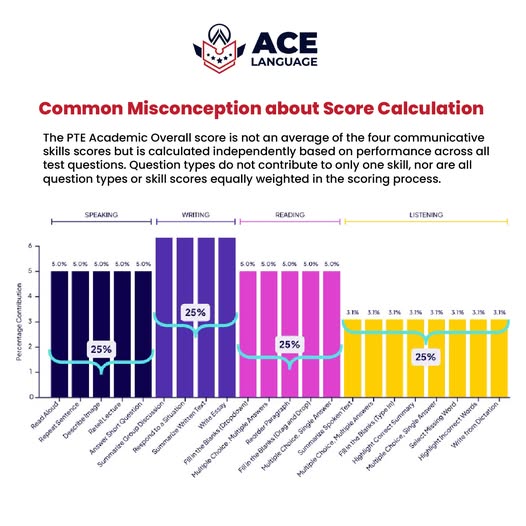
Looking at the chart, the four communicative skills appear roughly equal in terms of task distribution. However, this does not mean each skill contributes an exactly equal share to your overall score.
That’s the equal part. Here’s where it gets unequal.
Within each skill section, the individual task types do not all carry the same weight. Look at the Speaking section in the chart. Tasks like Read Aloud, Repeat Sentence, Describe Image, Re-tell Lecture, and Answer Short Question each show a 5.0% contribution.
But the Writing section tells a different story. Write Essay sits noticeably higher in the bar chart than the other Writing tasks. Summarise Written Text also carries meaningful weight. These two tasks are doing more heavy lifting inside that 25% Writing block than most test takers realise.
One Task, Multiple Skill Scores
Question types do not contribute to only one skill. A single task can feed into two communicative skill scores at the same time.
Write From Dictation, sitting in the Listening section of the chart, is one of the clearest examples. You hear audio and type what you hear. It contributes to your Listening score AND your Writing score. A weak performance on that one task type pulls down two numbers simultaneously.
The same logic applies to Re-tell Lecture feeding into both Listening and Speaking. Summarise Written Text feeding into both Reading and Writing.
This is why test takers who neglect their writing mechanics while preparing for listening tasks often get a surprise when their Writing communicative skill score comes back lower than expected. They didn’t fail at writing questions. They failed to realise that listening questions were also writing questions.
The Listening Section Has the Most Task Types, and They’re Not All Equal
Cast your eye across the Listening section of the chart. It has the most individual task types of any skill, including Summarise Spoken Text, Multiple Choice Single Answer, Multiple Choice Multiple Answer, Fill in the Blanks, Highlight Correct Summary, Multiple Choice Single Answer appears in two formats within the Listening section, each assessed differently, Select Missing Word, Highlight Incorrect Words, and Write From Dictation.
Most of those tasks show a 3.1% individual contribution. But Write From Dictation sits at 3.1% as well while also contributing to Writing. And Highlight Incorrect Words, which many test takers underestimate or rush through, carries the same weighting.
The practical takeaway here is that dismissing any individual listening task as “too small to matter” is exactly how test takers bleed marks they didn’t know they were losing.
Fill in the Blanks Appears in Two Different Sections for a Reason
There are actually three Fill in the Blanks variants across the test. The Reading version uses drag and drop. The Reading and Writing version uses dropdown selections and contributes to both Reading and Writing scores.
The Listening version contributes only to Listening. Treating them all as one task is a preparation mistake.
Reading Fill in the Blanks and Reading and Writing Fill in the Blanks are different tasks with different scoring mechanics. The Reading and Writing version contributes to both your Reading and Writing scores. The Listening Fill-in-the-Blanks contributes to Listening.
Test takers who lump all Fill in the Blanks tasks together and prepare for them as one task type are preparing for a test that doesn’t exist. Each version requires a different approach and rewards different skills.
What This Means for Your Preparation
Understanding the chart above isn’t just interesting. It changes where you put your time.
- If you’re sitting the PTE for Australian migration purposes and need a minimum score in each communicative skill, knowing that Write From Dictation feeds your Writing score as well as your Listening score means it deserves double the preparation attention it usually gets.
- If you’re targeting a specific overall score rather than individual skill minimums, you need to look at which tasks carry the highest individual percentage contribution and make sure those are tight. Writing an Essay at its elevated bar height in the Writing section is not a task to wing.
- The score report you get after your exam breaks down enabling skills including Grammar, Oral Fluency, Pronunciation, Spelling, Vocabulary, and Written Discourse. If your overall or any communicative skill score is lower than expected, start there. Those sub-scores will tell you exactly which task types to revisit before your next attempt.